Month: January 2026

  • Top 5 SHSM Compliance Risks & How to Protect Your SHSM Program

    Top 5 SHSM Compliance Risks & How to Protect Your SHSM Program

    Experiential learning is a cornerstone of the Specialist High Skills Major (SHSM) program. Through sector-specific placements, certifications, and authentic workplace experiences, SHSM connects classroom learning to real career pathways and helps students make informed postsecondary decisions.

    However, because SHSM operates at the intersection of curriculum expectations, sector standards, workplace safety, and Ministry policy, it is also one of the areas where compliance concerns most often emerge.

    The reality is this: most SHSM compliance issues are not caused by poor programming or lack of commitment. They usually stem from small gaps — incomplete documentation, weak sector alignment, or assumptions about what qualifies as acceptable SHSM evidence. Unfortunately, during reviews, even minor oversights can have significant consequences for student SHSM completion, program credibility, and staff workload.


    Why SHSM Compliance Matters More Than Ever

    The Ontario Ministry of Education is explicit that SHSM programming must meet specific policy requirements in order for students to earn their SHSM designation. Boards are required to maintain clear evidence that SHSM components are:

    • Sector-specific and intentional
    • Directly connected to curriculum expectations
    • Appropriately supervised and assessed
    • Fully documented

    This documentation feeds into:

    • Student SHSM records and transcripts
    • Board-level monitoring and reporting
    • Ministry reviews and audits

    When compliance issues arise, the impact is rarely isolated. One weak or poorly documented SHSM experience can trigger broader program scrutiny. (Ontario Ministry of Education, SHSM Policy and Implementation Guide)


    Risk #1: Incomplete or Inconsistent SHSM Documentation

    What This Looks Like

    • Missing or partially completed learning plans
    • Unsigned documentation (student, employer, or teacher)
    • Safety training or certifications not properly recorded
    • Assessment evidence stored informally or inconsistently

    Why It’s a Problem

    The Ministry requires that all SHSM experiential learning include documented learning goals, tasks, supervision, and assessment. Without clear documentation, there is no formal proof that SHSM learning occurred — even if the experience was meaningful.

    During audits, undocumented learning is treated as non-existent learning. (Ontario Ministry of Education, SHSM Policy and Implementation Guide).
    How to Avoid It

    • Use standardized SHSM templates across your school or board
    • Create a pre-placement checklist for SHSM requirements
    • Store all SHSM documentation in one consistent location
    • Conduct mid-semester file checks instead of waiting until the end

    Review-Proofing Tip:
    If it isn’t signed, dated, and retrievable, it doesn’t exist.


    Risk #2: Weak Sector Alignment

    What This Looks Like

    • SHSM experiences approved because they are convenient
    • Tasks that are generic or unrelated to sector outcomes
    • Employers unclear about SHSM expectations

    Why It’s a Problem

    SHSM requires that experiential learning directly support sector-specific knowledge and skills. Experiences that provide general work exposure but do not align with sector outcomes may not meet SHSM requirements. (Ontario Ministry of Education, SHSM Policy and Implementation Guide)

    For example:

    • A health SHSM student doing only clerical tasks
    • A construction SHSM student with no exposure to tools, processes, or safety practices
    • A business SHSM student with no engagement in planning, communication, or operations

    How to Avoid It

    • Review sector alignment before approval
    • Ask employers what skills students will practice daily
    • Explicitly link tasks to sector outcomes and curriculum expectations
    • Adjust placements early if alignment weakens

    Teacher Check:
    An experience doesn’t need to be perfect — but it must be defensible.

    Risk#3: Assuming Experiences Automatically “Count” Toward SHSM

    What This Looks Like

    • Students assuming any work experience qualifies
    • Retroactive approval of experiences
    • Learning plans created after experiences begin

    Why It’s a Problem

    SHSM experiences must be approved in advance, tied to a SHSM course, and supported by documented learning plans and assessment. Experiences that lack these elements cannot be retroactively converted into SHSM requirements. (Ontario Ministry of Education, SHSM Policy and Implementation Guide)

    How to Avoid It

    • Clarify SHSM expectations with students early
    • Require approval before experiences begin
    • Apply the same documentation and assessment standards to all SHSM experiences

    Risk #4: Weak or Missing Assessment Evidence

    What This Looks Like

    • Minimal employer feedback
    • Limited student reflection
    • Assessment focused on completion rather than learning

    Why It’s a Problem

    SHSM is not a participation badge. Teachers must be able to demonstrate skill development, reflection, and achievement aligned to curriculum and sector expectations. Hours or attendance alone do not demonstrate learning. (Ontario Ministry of Education, Growing Success)

    How to Avoid It

    • Use structured reflection prompts
    • Collect artifacts such as logs, photos, and supervisor feedback
    • Align rubrics with curriculum and sector outcomes
    • Schedule check-ins that generate evidence, not just conversation
    Risk #5: Waiting Until a Review or Audit to Fix Problems

    What This Looks Like

    • Scrambling for missing documents
    • Rewriting learning plans after completion
    • Inconsistent records across students

    Why It’s a Problem

    Reviews and audits assess existing evidence — not intentions. Late fixes often raise more concerns than they resolve.


    How to Review/Audit Proof Your SHSM Program

    • Build routine compliance checks into each semester
    • Share responsibility across SHSM teams
    • Train new teachers early on SHSM documentation expectations
    • Keep systems simple, consistent, and repeatable

    Quick SHSM Compliance Checklist

    ✔ Experience aligned to SHSM sector
    ✔ Learning plan completed before start
    ✔ Safety training documented
    ✔ Ongoing assessment evidence collected
    ✔ Employer feedback recorded
    ✔ All documents stored centrally


    Conclusion: SHSM Compliance Needs to Be Embedded into Processes

    SHSM compliance isn’t about bureaucracy — it’s about incorpating it as part of your SHSM processes.

    When SHSM experiences are well-aligned, well-documented, and well-assessed, they stand up to scrutiny and deliver meaningful value to students.

    With clear systems and shared understanding, SHSM compliance becomes manageable, defensible, and sustainable — even in the face of audits and policy change.

    ____________________________________________

    Flashpoint: Committed to Excellence & Education

    To support teachers and school boards in strengthening their understanding of SHSM roles and responsibilities, we, in collaboration with educational partners, will be launching a new professional learning course series in April 2026. This series is designed to support effective, compliant, and sustainable SHSM programming across Ontario. Courses will be available online starting at just $50 per participant. We also can provide live training sessions.
    a. SHSM 101: Understanding My Role as a SHSM Teacher

    This course provides Ontario educators with a clear and practical introduction to the Specialist High Skills Major (SHSM) program as outlined by the Ontario Ministry of Education. Participants will explore the purpose and structure of SHSM, its role within Ontario secondary education, and how it supports student pathways to apprenticeship, college, university, and the workplace. The course highlights how classroom instruction, experiential learning, and sector-specific programming work together to meet both curriculum expectations and Ministry policy requirements, positioning SHSM as an integrated component of student learning rather than an add-on program.

    Teachers will examine their specific responsibilities within SHSM delivery in Ontario schools, including collaboration with SHSM leads and guidance staff, supporting students through program requirements, and aligning instructional and assessment practices with Ministry expectations. By the end of the course, participants will have a clear understanding of how their role contributes to student success, program quality, and the integrity of SHSM implementation within the Ontario education system.

    b. Foundations of SHSM Compliance and Documentation

    This course supports Ontario educators in understanding the compliance and documentation requirements of the Specialist High Skills Major (SHSM) program as outlined by the Ontario Ministry of Education. Participants will examine Ministry expectations related to SHSM credits, experiential learning, sector alignment, assessment, and record-keeping, with a focus on the evidence required to support student SHSM completion. The course emphasizes that compliance is not simply an administrative task, but a critical component of program integrity, student protection, and Ministry accountability.

    Teachers will explore common compliance risks identified in SHSM implementation, including documentation gaps, misalignment with sector outcomes, and inconsistent assessment practices. Practical strategies will be shared to help teachers establish clear, manageable systems that support consistency, transparency, and audit readiness within Ontario school boards. By the end of the course, participants will be better equipped to maintain accurate, defensible SHSM records and to confidently

    c. Designing Effective SHSM Learning Experiences

    This course supports Ontario educators in designing Specialist High Skills Major (SHSM) learning experiences that are both meaningful for students and aligned with Ontario Ministry of Education expectations. Participants will explore what high-quality, sector-specific SHSM learning looks like in practice, with an emphasis on intentional planning, clear alignment to curriculum expectations, and authentic connections to industry sectors. The course reinforces the importance of designing SHSM experiences that support students’ pathway development while meeting program requirements.

    Teachers will examine strategies for translating SHSM policy and sector outcomes into well-designed learning experiences that are realistic, defensible, and responsive to student needs. Through practical examples and guided reflection, participants will develop tools to plan, refine, and evaluate SHSM learning experiences that demonstrate clear learning, skill development, and alignment with Ministry standards. By the end of the course, teachers will be better equipped to design SHSM learning that strengthens both student outcomes and program quality within Ontario schools.
    Comments or questions? Interested in learning more?

    Drop a line to hello@flashpointtraining.com and we will send you more information or add you to our course waiting list.

  • Micro-Credentials, Badges, and SHSM: How Do These Compare?

    Micro-Credentials, Badges, and SHSM: How Do These Compare?

    The Credential Landscape Is Changing

    In today’s rapidly evolving labour market, traditional diplomas and degrees no longer tell the whole story about a learner’s skills. While formal credentials still matter, employers and post-secondary institutions increasingly look for evidence of specific competencies, applied learning, and workforce readiness. In response, short, competency-based credentials such as micro-credentials and digital badges have gained significant traction.

    Micro-credentials are designed to recognize targeted skills in flexible, employer-responsive formats. They are particularly common in post-secondary education, workforce training, and professional development. As a result, SHSM students and teachers are encountering these credentials more frequently — through colleges, online platforms, employers, and industry organizations.

    However, the rise of micro-credentials also creates confusion. Teachers and students may assume that all credentials carry the same weight or that micro-credentials can replace required SHSM certifications. Understanding what these credentials actually are, how they differ from SHSM requirements, and what post-secondary institutions truly value is essential to protecting program integrity and supporting student transitions.

    Research from the Higher Education Quality Council of Ontario (HEQCO) confirms that while micro-credentials can play a meaningful role in skills recognition, their value depends heavily on quality assurance, employer recognition, and contextual relevance (HEQCO, 2023).

    What Are Micro-Credentials and Digital Badges?

    Micro-Credentials

    Micro-credentials are short, focused credentials that certify assessed learning in a specific skill or competency area. Unlike traditional courses or programs, they are not time-based; instead, they emphasize demonstrated mastery. Many micro-credentials are developed in collaboration with employers or industry groups to address specific workforce needs.

    According to eCampusOntario, micro-credentials are:

    • Skills-focused and outcomes-driven
    • Often completed in weeks or months rather than years
    • Designed to be stackable, meaning multiple micro-credentials may build toward a larger qualification or recognition
    • Grounded in assessment rather than participation alone (eCampusOntario, 2024)

    Digital Badges

    Digital badges are the visual and verifiable representation of learning achievement. They often accompany micro-credentials but may also represent certifications, training completion, or competency demonstrations.

    Badges typically:

    • Contain embedded metadata describing the issuing organization, criteria, and evidence
    • Can be shared on resumes, LinkedIn, portfolios, and digital wallets
    • Point to concrete proof of learning, such as projects or assessments

    In theory, badges increase transparency by allowing viewers to see what the learner actually did, not just the title of the credential (eCampusOntario, 2024).

    Important Quality Consideration

    At present, micro-credentials and badges are not governed by a single provincial regulatory body in Ontario. While frameworks such as Ontario’s Micro-Credential Quality Assurance Framework are emerging, recognition still varies widely by provider and sector (PEQAB, 2023). This means not all micro-credentials carry equal value, and teacher guidance is critical.

    How Micro-Credentials Differ from SHSM Certifications

    SHSM students already earn industry-recognized certifications and training that are mandated components of the SHSM program. These certifications are not optional enhancements — they are formal requirements outlined in Ministry policy.

    Examples include:

    • First Aid and CPR
    • WHMIS
    • Sector-specific safety or technical training
    • Workplace Essential Skills training embedded in co-op and experiential learning

    These SHSM certifications:

    • Are explicitly required by the SHSM Policy and Implementation Guide
    • Must be documented in student management systems
    • Appear on the SHSM Record and, where applicable, the Ontario Student Transcript
    • Are governed by required minimum length, duration and content
    • Are recognized by employers as foundational workplace credentials (Ontario Ministry of Education)

    By contrast, a most micro-credential:

    • Can be a SHSM course, but not necessarily
    • Are developed by post-secondary institutions or private/industry providers
    • Are not listed as required SHSM training
    • Do not automatically appear on secondary school transcripts or SHSM records
    • Serve as supplementary evidence of skill development rather than program completion

    Bottom Line Distinction

    ✔ SHSM certifications count toward SHSM completion
    ✘ Micro-credentials do not replace required SHSM certifications but can be SHSM courses if content and length meet SHSM requirements

    Micro-credentials can enhance a student’s pathway narrative when used strategically — particularly during transitions to post-secondary education or employment.

    What Postsecondary Institutions Actually Value

    When colleges and universities evaluate applicants, they do not rely on a single indicator. Instead, they assess a combination of:

    • Academic achievement
    • Evidence of relevant experiences
    • Demonstrated competencies aligned with program expectations

    Micro-credentials and badges can support applications when they clearly reinforce program fit. For example:

    • A cybersecurity micro-credential supporting an ICT or computer science pathway
    • A health-focused credential reinforcing readiness for allied health programs
    • A project-based credential demonstrating applied problem-solving or teamwork

    Post-secondary institutions value micro-credentials most when they:

    • Are issued by recognized, reputable organizations
    • Align directly with the field of study
    • Include transparent assessment criteria
    • Are supported by reflection or portfolio evidence

    Ontario colleges and universities are increasingly integrating micro-credentials into their own programming and registries, particularly through eCampusOntario’s Micro-credential Portal, which links credentials to labour market needs (eCampusOntario, 2024).

    However, institutions are cautious about generic or unverified badges that lack clear learning outcomes or employer recognition.

    Guidance for Teachers Supporting SHSM Students

    Teachers play a critical role in helping students interpret the value of micro-credentials realistically.

    Effective guidance includes:

    • Helping students articulate why a micro-credential matters for their pathway
    • Encouraging reflection pieces or portfolio artifacts alongside badges
    • Working with guidance counsellors to identify which credentials align with post-secondary expectations
    • Reinforcing that micro-credentials add depth, not replacement, to SHSM requirements

    When framed properly, micro-credentials can strengthen resumes, applications, and interviews by providing concrete talking points.

    How SHSM Teachers Can Use Micro-Credentials and Digital Badges Effectively

    1. Map credentials to sectors
      Identify which micro-credentials meaningfully align with SHSM sectors and communicate relevance clearly.
    2. Complement, don’t substitute
      Ensure required SHSM certifications are completed first. Micro-credentials should enhance, not replace, mandatory training.
    3. Support transition portfolios
      Include micro-credentials in portfolios, resumes, and application materials when they reinforce the student’s goals.
    4. Leverage employer partnerships
      Prioritize credentials recognized by employers or sector partners who can validate their relevance.

    Conclusion

    Micro-credentials and digital badges offer exciting possibilities for SHSM students — particularly as tools for demonstrating specialized skills, initiative, and self-directed learning. However, their value depends on quality, relevance, and alignment.

    It is essential to maintain a clear distinction between structured SHSM certifications required by Ministry policy and supplementary credentials that enhance a student’s pathway story (Ontario Ministry of Education). When used strategically — and grounded in student goals — micro-credentials can be a powerful complement to SHSM programming and post-secondary transition planning.

    The key is balance: embrace innovation without overclaiming its impact, and ensure every credential serves a clear, defensible purpose in the student’s journey.

    Sources

    • Higher Education Quality Council of Ontario (HEQCO), Micro-credentials in Ontario
    • eCampusOntario, Micro-credentials Portal and Framework
    • Postsecondary Education Quality Assessment Board (PEQAB), Ontario Micro-Credential Quality Assurance Framework
    • Ontario Ministry of Education, SHSM Policy and Implementation Guide
  • What’s New in Dual Credit & How It Impacts SHSM Students in 2026?

    What’s New in Dual Credit & How It Impacts SHSM Students in 2026?

    Dual credit programs have become an increasingly powerful option for high school students — especially those in Specialist High Skills Major (SHSM) pathways. But for many teachers, the evolving requirements and practical realities of dual credits can feel confusing:

    Who qualifies? How do they count? And how can we best leverage them to support SHSM students’ transitions to college, apprenticeships, or other post-secondary pathways?

    This blog breaks down what dual credit is, why it matters for SHSM learners, how eligibility works, and actions teachers can take now to ensure students benefit from these opportunities.

    What Is a Dual Credit Program?

    In Ontario, dual credit programs are Ministry of Education-approved opportunities that allow high school students to take college courses or Level 1 apprenticeship training while still enrolled in secondary school. The key benefit is that these courses count for both the Ontario Secondary School Diploma (OSSD) and can also count toward a post-secondary certificate, diploma, degree, or apprenticeship certification. Ontario

    Here’s what that looks like in practice:

    • Students take college-delivered or team-taught courses.
    • Successfully completing the course earns them a secondary school creditand a college credit simultaneously.
    • Students may earn up to four optional credits toward their OSSD this way.

    Dual credits are usually offered in partnership between public school boards and local colleges. They can be delivered directly at the college campus or through team-taught models at the secondary school.

    Why Dual Credit Matters for SHSM Students

    For SHSM students — who are already navigating sector-focused learning, experiential placements, certifications, and pathway planning — dual credit offers several strategic advantages:

    1. Reinforces Sector Pathways with Post-Secondary Exposure

    Dual credits allow students to explore college or apprenticeship coursework that aligns with their SHSM sector while still in high school. This means SHSM students can experience the next step of training before graduation, helping them make informed decisions about whether they want to pursue that pathway after high school. Ontario

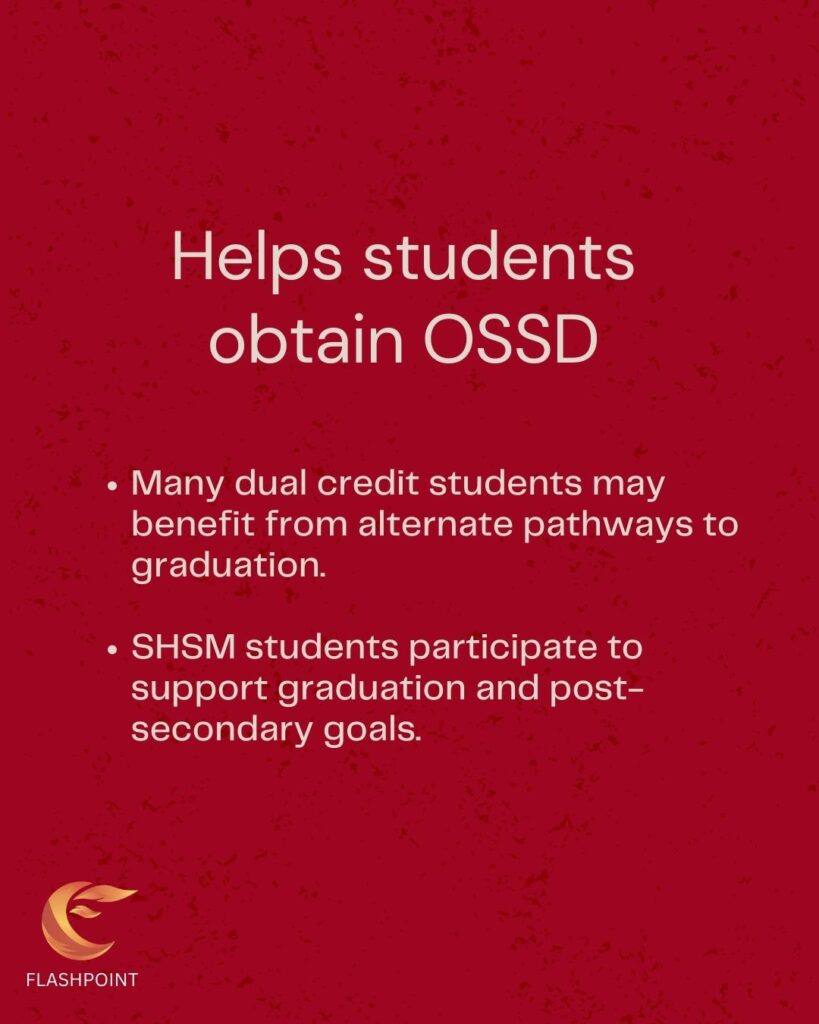
    2. Helps Students Complete Their OSSD

    Many dual credit participants are students who may benefit from alternative pathways to graduation — including those who might be at risk of not completing their OSSD. But SHSM students also qualify and are frequently encouraged to participate because the experience supports both graduation and post-secondary planning goals. Upper Grand District School Board

    3. Smooths the Transition to College or Apprenticeship

    By earning real college or Level 1 apprenticeship credits early and accessing college support services (like tutoring and career advising), students can enter post-secondary settings with less anxiety and a clearer sense of expectation. Dual credits help students build confidence, familiarity, and academic momentum. Ontario

    Who Is Eligible for Dual Credit?

    Eligibility isn’t automatic — it’s typically determined by the Student Success Team, guidance counsellors, and school administrators in collaboration with college partners. But broadly:

    • Students in Grade 11 or 12 can participate.
    • The program is aimed at students with the potential to succeed but who may need additional supports — this includes disengaged learners and those at risk of not graduating.
    • SHSM students are specifically included in the group of students who may benefit from dual credit programs.
    • Students in Ontario Youth Apprenticeship Program (OYAP) pathways can also participate in apprenticeship-focused dual credits. Upper Grand District School Board

    Teachers and guidance staff are key to identifying which students may be a good fit — not just those struggling academically, but also those who could gain confidence, clarity, and skills through a reach-ahead experience.

    What’s Changed (or Worth Noting) This Year?

    While the core policy framework hasn’t undergone a radical overhaul, there are a few practical shifts and renewals worth knowing:

    1. Updated Dual Credit Program Guidelines

    The Ontario Ministry of Education recently released updated Dual Credit Program Guidelines (2025–26), which clarify expectations around student selection, regional planning team operations, and reporting compliance for school boards and colleges. These guidelines reaffirm that SHSM students are a target group and outline how programs should be designed to meet local needs. Ontario

    Teacher takeaway: Understanding the updated guidelines helps you advocate for dual credit spaces that align with your students’ goals rather than relying on outdated assumptions about eligibility or delivery.

    2. Continued Emphasis on Supporting Diverse Learners

    Dual credit programs today continue to emphasize inclusion across learner profiles — including those who may benefit from alternative learning environments while still meeting academic requirements. This aligns very well with SHSM’s focus on experiential and contextualized learning. Ontario

    Practical Tips for Teachers (and Guidance Teams)

    Here are actionable approaches you can take right now to make dual credit a meaningful tool for SHSM students:

    1. Start Early — Identify Potential Candidates in Grade 10–11

    Many teachers only think about dual credit in Grade 12 — but early identification lets students plan their schedules more intentionally. Discuss dual credit options when students choose their Grade 11 and 12 courses, especially if the offerings align with their SHSM sector.

    2. Coordinate With Guidance and Student Success Teams

    These teams are central to tracking eligibility and securing seats, especially when dual credits are limited. Work collaboratively rather than in isolation to ensure students are on the radar early.

    3. Connect Dual Credit to SHSM Pathway Planning

    Show students and parents how the credits literally count twice: once toward the OSSD and once on their post-secondary transcript. Tie dual credit participation to other SHSM components (like co-op or sector partner experiences) so students can articulate their pathway story clearly.

    4. Communicate the Benefits (and Limitations)

    Dual credits are not mandatory and won’t count in the same way as required SHSM credits — but their value lies in transition, exploration, and reduced duplication of coursework once a student enters college or apprenticeship programs.

    Conclusion: A Strategic Tool for SHSM Success

    Dual credit programs aren’t just an add-on — they’re a strategic mechanism to support SHSM learners in finishing strong and starting next steps confidently. By earning up to four optional credits toward graduation and college or apprenticeship credentials, students can get a head start on post-secondary success while still in a familiar learning environment.

    Teachers who proactively understand eligibility, communicate options to students early, and align dual credit experiences with SHSM pathway goals give students an inside edge — academically, professionally, and personally.

  • Can Students Be Paid for Placements — and Why Does It Matter?

    Can Students Be Paid for Placements — and Why Does It Matter?

    One of the questions that we always get, both from students and teachers, is can co-op students be paid for placements?

    Work placements are one of the most valuable components of both Co-operative Education (Co-op) and Specialist High Skills Major (SHSM) programs. They give students a chance to apply classroom learning in real workplaces, explore career options, and build skills that matter — regardless of whether they’re headed to apprenticeship, college, university, or the workplace. 

    But one question keeps coming up among teachers, students, and parents alike: Should a placement be paid or unpaid? The answer isn’t as simple as “paid is better.” What matters most — and what teachers need to communicate clearly — is how a work experience fits educationally and legally into SHSM and co-op requirements.

    The answer is that it depends. There is not a straightforward answer. It can change board to board with significant variance across the province.

    Understanding the Basics: What Co-op Is and Isn’t

    Co-operative Education (or “co-op”) in Ontario is a ministry-approved program that allows students to earn high school credits through workplace placements tied to their curriculum. These placements are arranged by the school and are designed to relate directly to classroom learning and career exploration. Ontario

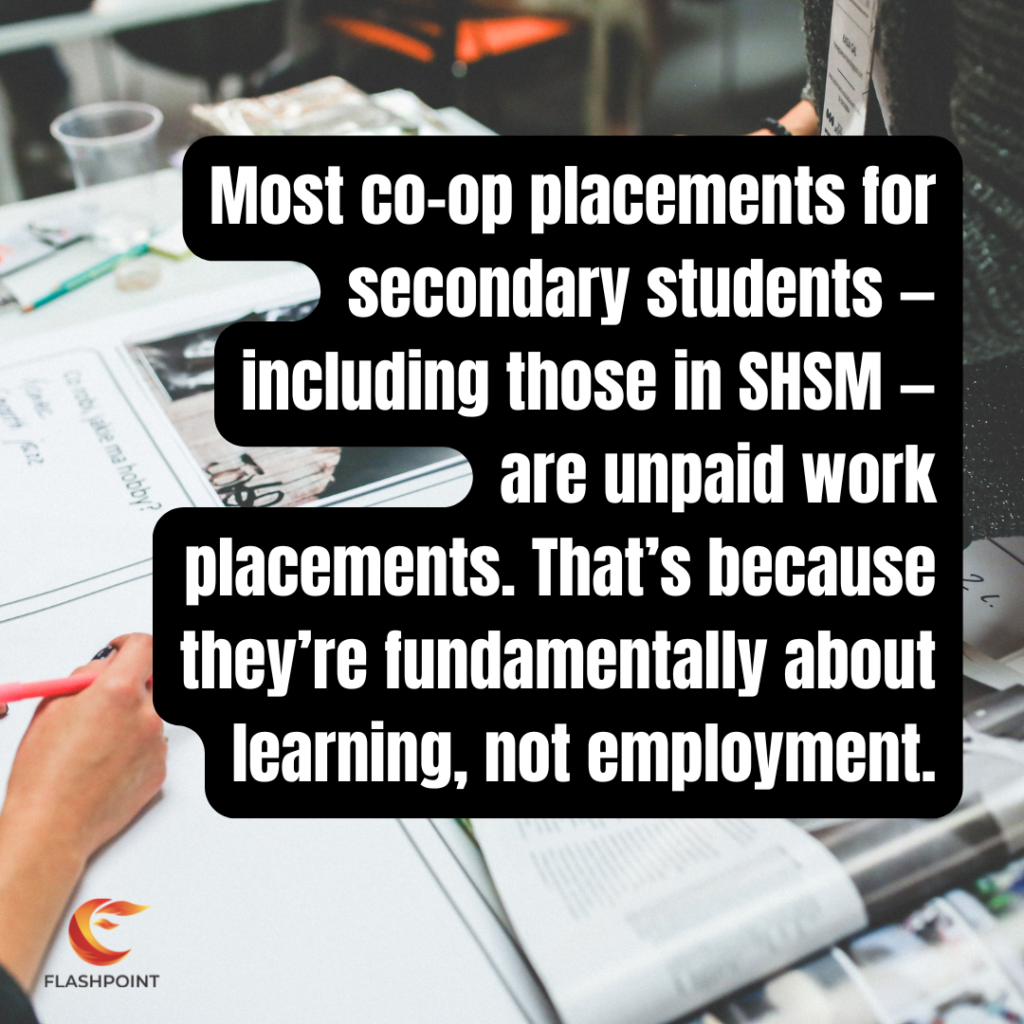
    Most co-op placements for secondary students — including those in SHSM — are unpaid work placements. That’s because they’re fundamentally about learning, not employment. These unpaid placements earn students credits, help them explore careers, and build their portfolio of skills and experience. Ontario

    Paid vs. Unpaid: What’s the Difference (Legally & Practically)

    Unpaid Placements

    • Educationally Required: Unpaid placements are embedded within a curriculum course, especially co-op tied to SHSM. The priority is on learning outcomes, not compensation. Ontario
    • Legal Framework: In Ontario, unpaid placements are permitted only when they are part of a formal educational program — such as high school co-op, college co-ops, or professional practicums. Outside this framework, unpaid placements can violate employment standards. LaunchKO+1
    • Outcome-Focused: The goal isn’t income but skill acquisition, reflection, and documentation that aligns with curriculum expectations. Ontario

    Because SHSM requires students to complete two co-op credits directly connected to their sector, these unpaid placements are standard — and they count toward graduation and SHSM requirements. Upper Grand District School Board

    Paid Placements

    A paid placement means the student is treated as an employee under the Ontario Employment Standards Act (ESA). This has significant legal and logistical implications:

    • Minimum Wage & Employment Standards: If a student is paid, they must receive at least minimum wage and all other ESA protections (vacation pay, statutory benefits, etc.). LaunchKO
    • WSIB and Insurance: Paid students must be covered under workplace insurance appropriate to paid employees — which differs from how unpaid student placements are covered (often by the board or educational insurer). LaunchKO
    • Education vs. Employment: Paid work may not meet the Ministry of Education’s co-op criteria for curriculum-linked learning unless it is structured as a formal co-op program approved by the school. Ontario

    For SHSM students, this matters because only learning-focused placements can be counted toward co-op credits — they must include planned learning experiences, supervision, reflection, and assessment designed by the school. Ontario

    When Paid Work Can Be Compatible With SHSM Goals

    It is possible for a student to undertake paid work that supports their SHSM pathway — but not all paid jobs qualify as co-op or educational placements. Here’s how teachers can distinguish them:

    ✔ Approved Co-op Employers Offering Paid Co-op Roles

    Some employer partners are willing to pay students but structure the work as an approved co-op placement with a learning plan, supervision, and curriculum linkages. In these cases:

    • The student stays in the educational co-op framework.
    • The work still earns a co-op credit because it meets the Ministry and board criteria.
      Teachers must confirm ahead of time that the role will be treated as co-op with the school’s approval.

    ✔ Paid Work That Doesn’t Count as Co-op

    A student’s part-time job or casual paid work — even if it’s in a relevant sector — is not automatically a co-op placement. Unless the school structured it as part of a co-op course with learning objectives and assessment, it cannot be used toward SHSM requirements.

    Highlight this distinction to students: earning money is valuable, but it doesn’t substitute for co-op credit unless it’s formally recognized as such.

    Key Risks Teachers Should Help Students Avoid

    ❗ Misclassifying Work as a Co-op Placement

    A common pitfall is assuming that any job in a related sector counts as co-op. It does not — unless the school has integrated it into the co-op curriculum plan with learning, assessment, and supervision. Ontario

    ❗ Skipping Learning Plans

    Even with paid placements, students must have a Student Cooperative Education Learning Plan that identifies goals, activities, and assessment criteria before placement starts. Without it, the experience may be disallowed in SHSM audits.

    ❗ Ignoring Insurance and Legal Coverage

    Paid roles must be treated as employment; boards and employers need to establish correct insurance and safety coverage. Missteps here can put both students and schools at risk. LaunchKO

    What Teachers Should Tell Students (And Parents)

    Here are concise messages you can use with students — either in classroom presentations, individual planning, or parent communications:

    • “Paid work is great — but it only counts toward your SHSM co-op if we’ve approved it through the co-op program.”
    • “Unpaid co-op placements are educational first; they are designed to help you reflect on your learning, not just work.”
    • “Before you accept any job as part of SHSM co-op, let’s check if we can build a learning plan and link it to your curriculum.”

    Bottom Line: Protecting Students and Program Integrity

    Paid employment has real benefits — especially for students needing income — but it is not interchangeable with co-op placement unless properly structured. Unpaid co-op placements remain the core way that SHSM students earn credits, develop sector-specific skills, and demonstrate readiness for post-secondary pathways. Ontario

    Some school boards permit paid placements during summer,while others only after school. 

    Regardless of the school board position, it is important to set expectations and ensure that  students, parents and employers all understand the rules, responsibilities and expectations of the work placement.

    Your role as a teacher is to help students navigate the difference, make choices that align with both their learning and legal requirements, and ensure that every work experience counts toward their success — academically, professionally, and developmentally.