Category: Uncategorized

  • What’s New in Dual Credit & How It Impacts SHSM Students in 2026?

    What’s New in Dual Credit & How It Impacts SHSM Students in 2026?

    Dual credit programs have become an increasingly powerful option for high school students — especially those in Specialist High Skills Major (SHSM) pathways. But for many teachers, the evolving requirements and practical realities of dual credits can feel confusing:

    Who qualifies? How do they count? And how can we best leverage them to support SHSM students’ transitions to college, apprenticeships, or other post-secondary pathways?

    This blog breaks down what dual credit is, why it matters for SHSM learners, how eligibility works, and actions teachers can take now to ensure students benefit from these opportunities.

    What Is a Dual Credit Program?

    In Ontario, dual credit programs are Ministry of Education-approved opportunities that allow high school students to take college courses or Level 1 apprenticeship training while still enrolled in secondary school. The key benefit is that these courses count for both the Ontario Secondary School Diploma (OSSD) and can also count toward a post-secondary certificate, diploma, degree, or apprenticeship certification. Ontario

    Here’s what that looks like in practice:

    • Students take college-delivered or team-taught courses.
    • Successfully completing the course earns them a secondary school credit and a college credit simultaneously.
    • Students may earn up to four optional credits toward their OSSD this way.

    Dual credits are usually offered in partnership between public school boards and local colleges. They can be delivered directly at the college campus or through team-taught models at the secondary school.

    Why Dual Credit Matters for SHSM Students

    For SHSM students — who are already navigating sector-focused learning, experiential placements, certifications, and pathway planning — dual credit offers several strategic advantages:

    1. Reinforces Sector Pathways with Post-Secondary Exposure

    Dual credits allow students to explore college or apprenticeship coursework that aligns with their SHSM sector while still in high school. This means SHSM students can experience the next step of training before graduation, helping them make informed decisions about whether they want to pursue that pathway after high school. Ontario

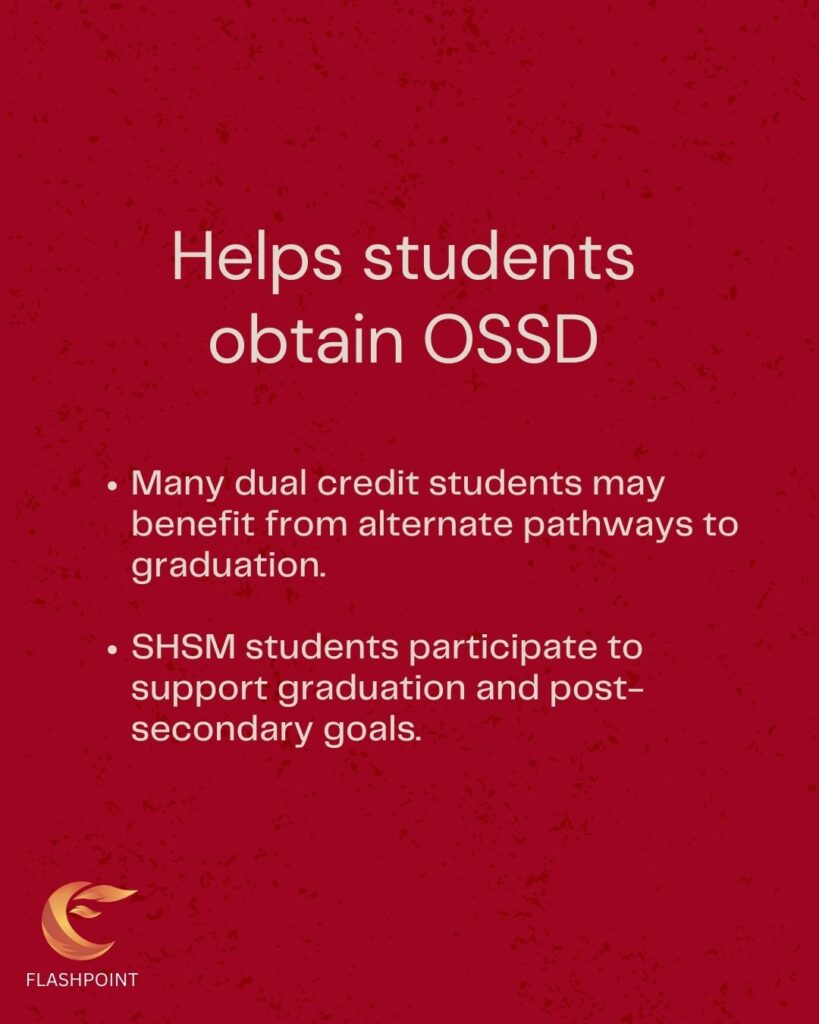
    2. Helps Students Complete Their OSSD

    Many dual credit participants are students who may benefit from alternative pathways to graduation — including those who might be at risk of not completing their OSSD. But SHSM students also qualify and are frequently encouraged to participate because the experience supports both graduation and post-secondary planning goals. Upper Grand District School Board

    3. Smooths the Transition to College or Apprenticeship

    By earning real college or Level 1 apprenticeship credits early and accessing college support services (like tutoring and career advising), students can enter post-secondary settings with less anxiety and a clearer sense of expectation. Dual credits help students build confidence, familiarity, and academic momentum. Ontario

    Who Is Eligible for Dual Credit?

    Eligibility isn’t automatic — it’s typically determined by the Student Success Team, guidance counsellors, and school administrators in collaboration with college partners. But broadly:

    • Students in Grade 11 or 12 can participate.
    • The program is aimed at students with the potential to succeed but who may need additional supports — this includes disengaged learners and those at risk of not graduating.
    • SHSM students are specifically included in the group of students who may benefit from dual credit programs.
    • Students in Ontario Youth Apprenticeship Program (OYAP) pathways can also participate in apprenticeship-focused dual credits. Upper Grand District School Board

    Teachers and guidance staff are key to identifying which students may be a good fit — not just those struggling academically, but also those who could gain confidence, clarity, and skills through a reach-ahead experience.

    What’s Changed (or Worth Noting) This Year?

    While the core policy framework hasn’t undergone a radical overhaul, there are a few practical shifts and renewals worth knowing:

    1. Updated Dual Credit Program Guidelines

    The Ontario Ministry of Education recently released updated Dual Credit Program Guidelines (2025–26), which clarify expectations around student selection, regional planning team operations, and reporting compliance for school boards and colleges. These guidelines reaffirm that SHSM students are a target group and outline how programs should be designed to meet local needs. Ontario

    Teacher takeaway: Understanding the updated guidelines helps you advocate for dual credit spaces that align with your students’ goals rather than relying on outdated assumptions about eligibility or delivery.

    2. Continued Emphasis on Supporting Diverse Learners

    Dual credit programs today continue to emphasize inclusion across learner profiles — including those who may benefit from alternative learning environments while still meeting academic requirements. This aligns very well with SHSM’s focus on experiential and contextualized learning. Ontario

    Practical Tips for Teachers (and Guidance Teams)

    Here are actionable approaches you can take right now to make dual credit a meaningful tool for SHSM students:

    1. Start Early — Identify Potential Candidates in Grade 10–11

    Many teachers only think about dual credit in Grade 12 — but early identification lets students plan their schedules more intentionally. Discuss dual credit options when students choose their Grade 11 and 12 courses, especially if the offerings align with their SHSM sector.

    2. Coordinate With Guidance and Student Success Teams

    These teams are central to tracking eligibility and securing seats, especially when dual credits are limited. Work collaboratively rather than in isolation to ensure students are on the radar early.

    3. Connect Dual Credit to SHSM Pathway Planning

    Show students and parents how the credits literally count twice: once toward the OSSD and once on their post-secondary transcript. Tie dual credit participation to other SHSM components (like co-op or sector partner experiences) so students can articulate their pathway story clearly.

    4. Communicate the Benefits (and Limitations)

    Dual credits are not mandatory and won’t count in the same way as required SHSM credits — but their value lies in transition, exploration, and reduced duplication of coursework once a student enters college or apprenticeship programs.

    Conclusion: A Strategic Tool for SHSM Success

    Dual credit programs aren’t just an add-on — they’re a strategic mechanism to support SHSM learners in finishing strong and starting next steps confidently. By earning up to four optional credits toward graduation and college or apprenticeship credentials, students can get a head start on post-secondary success while still in a familiar learning environment.

    Teachers who proactively understand eligibility, communicate options to students early, and align dual credit experiences with SHSM pathway goals give students an inside edge — academically, professionally, and personally.

  • How to Turn Interview Anxiety into Interview Confidence

    How to Turn Interview Anxiety into Interview Confidence

    Over the past several weeks, we’ve noticed a consistent and encouraging theme across our sessions: students are genuinely eager for guidance on how to succeed in their interviews. Whether it’s for a co-op placement, a part-time job, or a summer opportunity, many are navigating the interview process for the very first time. It’s common to see students approach our facilitators before or after a session with the same pressing question: “How do I ace my interview?”

    And it’s no wonder they’re asking. A quick search online reveals an avalanche of tips, tricks, lists, and contradicting opinions. Should they memorize answers—or avoid sounding rehearsed? Should they focus on selling themselves—or keep things humble? Should they ask lots of questions—or only a few? The sheer volume of mixed messages can leave students feeling more confused than prepared.

    That’s why, this week, we’re taking a step back and grounding the conversation in what we’ve learned from years of real-world interviewing, coaching, and working directly with youth.

    Our goal: to cut through the noise and explore the practical, evidence-informed strategies that genuinely help students.

    Most importantly, we’ll look at how to support them in transforming that very normal interview anxiety into clarity, calm, and authentic confidence.

    The Reality: It is Tough Out There Right Now and Competitive

    Gone are the days of more jobs than kids. It is tough to get a placement. It is tough to get your first job. But it is not impossible. Simplifying the interview process is key .

    1. Explain What Co-op Interviews Are Actually Like

    A major source of stress for students is imagining an interview as something stiff, formal, and intimidating—something out of a job-hunting movie scene. Teachers can remove a great deal of anxiety just by clarifying what co-op interviews typically look like. Most of the time, they are:

    • Short and relaxed, usually lasting around 10–20 minutes.
    • Conversational rather than formal, focused on getting to know the student as a person.
    • Centered around attitude and reliability, not a list of past experiences.

    When students understand that the interviewer isn’t expecting a polished professional, but simply a curious and responsible young person, their nerves begin to settle. Sometimes the simplest reassurance—“this is a conversation, not a test”—makes all the difference.

    2. Help Students Build a Strong Introduction

    Almost every interview starts with a version of “Tell me about yourself,” and it’s one of the questions that students fear most. Without structure, they feel unsure of where to start or what an adult wants to hear. Giving them a simple framework makes this so much easier.

    A reliable method teachers can use is the Present → Past → Future structure:

    • Present: Who they are now and what they’re interested in.
    • Past: Something from school or life connected to that interest.
    • Future: What they hope to gain from the co-op experience and identify what Value you bring to a prospective employer and workplace.

    This simple flow allows students to speak naturally and confidently. Once they rehearse it a few times, the introduction becomes a grounding moment instead of a stressful one, and it sets a positive tone for the rest of the interview.

    3. Identify Their Strengths—Even Without Job Experience

    Many students walk into interview prep convinced they have “nothing to offer.” Teachers can help them recognize that their day-to-day school life already reveals strengths that matter in the workplace. You can guide them to pull from:

    • School-based experiences, such as group projects, class presentations, or volunteer hours.
    • Personal strengths, like organization, creativity, attention to detail, or tech comfort.
    • Workplace-ready behaviours, such as reliability, punctuality, and willingness to learn.

    Once students see these strengths clearly, help them turn them into polished statements. Saying “I’m dependable and I always finish what I start” or “I learn quickly and ask good questions” helps students articulate their value with confidence—no job history required.

    4. Teach the “Core Four” Interview Questions

    While every interview is different, most co-op supervisors ask variations of the same four topics. When students can answer these confidently, they’re prepared for almost anything. Focus on:

    • Why they want the placement — helps employers understand interest and motivation.
    • What strengths they bring — showcases their readiness and mindset. Focus on examples that demonstrate growth
    • What they hope to learn — signals openness and curiosity.
    • How they handle challenges — shows maturity and problem-solving. This is the basis of scenario questions. Showcase examples that highlight maturity. Preparing students to handle scenario based questions will help them to respond.

    By practicing these Core Four, students learn to respond thoughtfully without memorizing anything. It’s about understanding the message they want to convey, not perfect wording.

    5. Conduct Low-Pressure Mock Interviews

    Nothing builds comfort like practice, but that practice doesn’t need to feel formal or intimidating. Teachers can create simple, low-stakes scenarios that help students build familiarity with interview flow. Try:

    • Quick paired interviews using basic question prompts.
    • Short mock interviews led by the teacher, focusing more on tone than perfection.
    • Mini “speed interview” stations, letting students practice multiple questions in a row.

    These activities help students see interviews as conversations rather than performances. The goal is comfort, not memorizing answers—helping students feel steady when it’s time for the real thing.

    6. Teach Simple Professional Behaviour

    Before the interview day arrives, students should understand a few foundational professional behaviours that make a strong first impression. Focus on three essentials:

    • Arrive prepared and a little early, showing reliability and respect for the interviewer’s time.
    • Communicate confidently, using eye contact, clear speech, and attentive body language.
    • Demonstrate professionalism, such as keeping phones away and saying thank you.

    These small actions don’t require experience—they simply show a student is ready to participate thoughtfully in a workplace environment.

    7. Prepare a Small Set of Questions Students Can Ask

    Students are often caught off guard when the interviewer flips the conversation and asks, “Do you have any questions for us?” Helping them plan ahead avoids that uncomfortable silence and shows genuine interest. Encourage them to choose one or two simple questions, such as:

    • “What does a typical day look like for a co-op student here?”
    • “What skills are most helpful in this role?”
    • “What would success look like for me in this placement?”

    These questions show maturity, curiosity, and readiness to learn—three qualities every employer values.

    8. Build a Calm, Encouraging Debrief After the Interview

    Reflection is where real growth happens. After their interview, give students a chance to think about the experience with a supportive lens. Guide them through three prompts:

    • What went well? (confidence-building)
    • What was challenging or unexpected? (awareness-building)
    • What would you adjust next time? (skill-building)
    • Remember your post interview follow up-extending thanks via a simple email or thank you card. It will help you stand out.
    • Remember to follow up-Follow up with the interviewer/contact a few days later if you have not heard anything

    This reframes interviews not as “pass or fail” moments but as stepping stones toward confidence and competence.

    Final Thought: First Interviews Aren’t About Perfection—They’re About Potential

    The purpose of a student’s first interview isn’t to display years of experience—it’s to show attitude, curiosity, and readiness to learn. With supportive preparation, clear structure, and small practice moments, teachers can help every student walk into their interview with confidence. When students understand that employers are looking for potential, not perfection, the entire experience becomes far less intimidating and far more empowering.

    By Carmen Reis, CEO – Flashpoint Training, Inc.

  • Beyond the Classroom: How SHSM Experiences Ignite Real-World Skills Students Actually Use

    Beyond the Classroom: How SHSM Experiences Ignite Real-World Skills Students Actually Use

    The Classroom is Changing

    Ontario’s classrooms are evolving — and so are the expectations placed on educators. Today’s students need more than lessons and lectures; they need experiences that prepare them for real opportunities beyond graduation. That’s where SHSM (Specialist High Skills Major) experiences step in — connecting curriculum with the real world in ways that spark passion, purpose, and possibility.

    At Flashpoint Training, we’ve seen how the right SHSM experience can transform learning. When students step out of the classroom and into a professional environment — whether it’s a live industry workshop, a hands-on certification, or a challenge-driven hackathon — something shifts. They stop memorizing content and start building the skills they’ll actually use.

    What Makes an SHSM Experience Truly “Real-World”?

    Not every field trip or workshop delivers meaningful impact. The most powerful SHSM experiences are intentionally designed to mirror real industry challenges while aligning with curriculum outcomes. Students aren’t just participants — they’re collaborators, problem-solvers, and innovators.

    A real-world experience brings three essential elements together:

    • Authentic context: Students engage directly with professionals and see how classroom concepts apply in real workplaces.
    • Active learning: Hands-on activities and scenario-based challenges turn abstract theory into practical skill.
    • Reflection and connection: Guided discussions help students connect their experience back to career pathways and SHSM learning goals.

    When these elements come together, learning sticks — and educators see stronger engagement, deeper understanding, and measurable growth in essential skills like communication, teamwork, and innovation.

    Skills That Stick: What Students Actually Learn

    Every SHSM coordinator knows the difference between a “fun trip” and a transformative one. The best experiences don’t just entertain — they build the soft and technical skills that truly prepare students for the next step.

    Here’s what we see every day when students take part in hands-on SHSM experiences:

    • Communication That Connects: Whether they’re pitching an idea to industry experts or collaborating with peers during a simulation, students learn how to communicate clearly, confidently, and professionally. The connections are so strong that they literally will wait in line for over an hour to talk to a facilitator or one of our career speakers
    • Innovation in Action: SPE/ICE and Hackathon-style programs challenge students to think critically and creatively. They’re not just solving hypothetical problems — they’re designing real solutions inspired by real workplaces. The excitement that fills the air when these students are in active competition, is a great feeling.
    • Confidence Through Experience: When students complete certifications or apply skills in an authentic setting, their self-belief grows. They begin to see themselves as capable, employable, and ready to lead. However, we put this into action. Students are REQUIRED to present, to stand in front of a group and state their ideas and defend them.

    These moments are what make SHSM so powerful. Students don’t just check boxes for a credit — they discover new strengths, explore career possibilities, and connect their classroom learning to the world around them.

    Meeting SHSM Requirements Without the Headache

    Between ICE hours, SPE components, certifications, and ministry documentation, coordinating SHSM programming can feel like a full-time job. That’s why smart planning — and the right partners — make all the difference.

    At Flashpoint, we design turnkey SHSM experiences that meet multiple deliverables at once.

    Each program is built with compliance and curriculum alignment in mind, so you can feel confident that every hour counts. Whether it’s:

    • An SPE/ICE session with a career reach ahead
    • A post-secondary opportunity aligned with a specific sector, or
    • A custom field trip tailored to your students’ goals and passions,

    our programs simplify the process and elevate the impact.

    You focus on inspiring your students — we’ll handle the logistics, alignment, and documentation

    A Glimpse Into the Future: Why Experiential Learning Matters More Than Ever

    The world your students are entering is changing faster than ever. Employers now value adaptability, creativity, and collaboration as much as technical know-how. Experiential learning bridges that gap — helping students apply what they know, test new ideas, and build confidence in real situations.

    Through SHSM experiences, students don’t just prepare for a job — they begin to see themselves as contributors to their communities and future industries. These experiences turn curiosity into confidence and help students discover career paths that truly resonate with their strengths and interests.

    When learning feels real, motivation follows. And that’s when education becomes more than preparation — it becomes transformation.

    Bring Learning to Life with Flashpoint

    At Flashpoint Training, we believe every student deserves a chance to see where their skills can take them. Our SHSM experiences are designed to inspire curiosity, strengthen essential skills, and meet every program requirement — all while keeping engagement at the heart of learning.

    Ready to design an SHSM experience your students, parents and administration will all love?

    Reach out to us at: hello@flashpointtraining.com and let us design a SHSM Experience -in class or offsite–your students will remember for years to come.

    Carmen is the CEO of Flashpoint Training and has spent a decade designing, evaluating and working with Experiential learning programs, building partnerships and growing training capacity across Ontario.

    Upcoming SPE/ICE Events:


    $99 MARCH 26  SPE/ICE with Flashpoint Training - Learning with Lego

    $99 MARCH 26 SPE/ICE with Flashpoint Training – Learning with Lego

    March 26, 2026 10:00 am
    North York Central Library
    $125 MARCH SPE-ICE with Flashpoint Training and Destination Toronto

    $125 MARCH SPE-ICE with Flashpoint Training and Destination Toronto

    March 31, 2026 10:00 am
    Canoe Landing Community Recreation Centre
    $99 APRIL SPE/ICE with Samsung Canada (TENTATIVE DATE)

    $99 APRIL SPE/ICE with Samsung Canada (TENTATIVE DATE)

    April 1, 2026 10:00 am
    Samsung Canada
    $129 APRIL SPE/ICE with Flashpoint Training and the Jays Care Foundation (TENTATIVE DATE)

    $129 APRIL SPE/ICE with Flashpoint Training and the Jays Care Foundation (TENTATIVE DATE)

    April 8, 2026 10:00 am
    Canoe Landing Community Recreation Centre
    $115 APRIL 9  SPE/ICE with Flashpoint Training - Learning with Lego

    $115 APRIL 9 SPE/ICE with Flashpoint Training – Learning with Lego

    April 9, 2026 10:00 am
    Waterfront Neighbourhood Centre
    $129 April SPE/ICE with Flashpoint Training + Toronto Blue Jays Game

    $129 April SPE/ICE with Flashpoint Training + Toronto Blue Jays Game

    April 10, 2026 11:30 am
    Canoe Landing Community Recreation Centre
    APRIL SPE-ICE with Flashpoint Training and the Toronto Zoo

    APRIL SPE-ICE with Flashpoint Training and the Toronto Zoo

    April 15, 2026 10:00 am
    Toronto Zoo
    $129 APRIL SPE/ICE with Flashpoint Training + TFC Game Tickets

    $129 APRIL SPE/ICE with Flashpoint Training + TFC Game Tickets

    April 22, 2026 11:30 am
    Canoe Landing Community Recreation Centre
    $129 MAY SPE/ICE with Flashpoint Training and TFC (TENTATIVE DATE)

    $129 MAY SPE/ICE with Flashpoint Training and TFC (TENTATIVE DATE)

    April 22, 2026 11:30 am
    BMO Field
    $129 APRIL SPE/ICE with Flashpoint Training and the Toronto Blue Jays (TENTATIVE DATE)

    $129 APRIL SPE/ICE with Flashpoint Training and the Toronto Blue Jays (TENTATIVE DATE)

    April 29, 2026 10:00 am
    Canoe Landing Community Recreation Centre
    $99 APRIL SPE-ICE with Flashpoint Training and Stackt Market

    $99 APRIL SPE-ICE with Flashpoint Training and Stackt Market

    April 30, 2026 10:00 am
    Stackt Market
    $99  MAY SPE/ICE with Flashpoint Training and Samsung Canada (TENTATIVE DATE)

    $99 MAY SPE/ICE with Flashpoint Training and Samsung Canada (TENTATIVE DATE)

    May 6, 2026 10:00 am
    Samsung Canada
    $129 MAY SPE/ICE with Flashpoint Training and the Toronto Blue Jays (TENTATIVE DATE)

    $129 MAY SPE/ICE with Flashpoint Training and the Toronto Blue Jays (TENTATIVE DATE)

    May 13, 2026 10:00 am
    Canoe Landing Community Recreation Centre
    $129 MAY SPE/ICE with Flashpoint Training + Toronto Blue Jays Game

    $129 MAY SPE/ICE with Flashpoint Training + Toronto Blue Jays Game

    May 13, 2026 11:30 am
    Canoe Landing Community Recreation Centre
    $109 MAY Portfolio Development with Flashpoint Training +  Toronto Blue Jays Game

    $109 MAY Portfolio Development with Flashpoint Training + Toronto Blue Jays Game

    May 27, 2026 9:00 am
    Canoe Landing Community Recreation Centre
    $109 MAY Personality Inventory with Flashpoint Training + Toronto Blue Jays Game

    $109 MAY Personality Inventory with Flashpoint Training + Toronto Blue Jays Game

    May 27, 2026 9:00 am
    Canoe Landing Community Recreation Centre
    $129 MAY SPE/ICE with Flashpoint Training and the Jays Care Foundation (TENTATIVE DATE)

    $129 MAY SPE/ICE with Flashpoint Training and the Jays Care Foundation (TENTATIVE DATE)

    May 27, 2026 10:00 am
    Canoe Landing Community Recreation Centre
    $129 JUNE SPE/ICE with Flashpoint Training + Toronto Blue Jays Game

    $129 JUNE SPE/ICE with Flashpoint Training + Toronto Blue Jays Game

    June 5, 2026 11:30 am
    Canoe Landing Community Recreation Centre
  • Who Trains SHSM Teachers?

    Who Trains SHSM Teachers?

    Each September, hundreds of educators across Ontario take on the role of SHSM Lead — coordinating certifications, planning Reach-Ahead experiences, and ensuring their students complete all components of the Specialist High Skills Major.

    But there’s a quiet truth behind the program’s success:
    Most SHSM Leads are learning how to run it while they’re already running it.

    A Patchwork of Guidance

    Across the province, SHSM training looks different in every board.
    Some teachers inherit binders and folders from their predecessors. Others attend a brief PD session in the fall, led by a board coordinator who’s balancing dozens of programs. A few lucky ones connect with a mentor who’s been through it before.

    There is no standardized onboarding — no single, shared understanding of what a “compliant” SHSM looks like.
    Each school builds its own rhythm, its own documentation system, its own interpretation of Ministry expectations.

    The Cost of Inconsistency

    That variability shows up everywhere:

    • Data that looks different from school to school.
    • Certifications recorded one way in one place, and another elsewhere.
    • Evidence that’s difficult to verify during audits.
    • Staff turnover that resets a program’s momentum each time someone new steps in.

    Despite these challenges, teachers make it work — often through collaboration, creativity, and long hours spent navigating systems meant to simplify, but not to teach.

    How Do We Know?

    We’ve seen it firsthand.
    Our work with school boards across Ontario has shown us just how dedicated — and often overwhelmed — SHSM Leads can be.
    We’ve stood beside teachers as they launched their first SHSM programs, helping them navigate requirements, build partnerships, and understand the mountain of compliance details that come with the role.

    We’ve listened to the same story again and again:

    “I love the program — I just wish someone had shown me how to do it right from the start.”

    What is standard in one place, is not the standard in another.

    The truth is, Ontario’s SHSM success depends not just on great students, but on confident, well-supported teachers.
    And right now, many of them are figuring it out on their own.

    The Question Worth Asking

    Ontario’s SHSM programs are designed to connect education and industry, to make learning hands-on and future-focused.
    Yet the educators who deliver those programs often have to teach themselves how to stay compliant, how to track effectively, and how to prepare for audits that can impact funding and credibility.

    If SHSM is meant to model innovation, shouldn’t the way we train and support its teachers reflect that too?

    By Carmen Reis, CPA, MA

    ____________________________________________

    Carmen is the CEO of Flashpoint Training and has spent a decade designing, evaluating and working with Experiential learning programs, building partnerships and growing training capacity across Ontario.

    We welcome your questions, comments and inquiries.

    If you would like to reach Carmen or any member of our team, email hello@flashpointtraining.com

  • SPE/ICE with Flashpoint and Samsung

    SPE/ICE with Flashpoint and Samsung

    Flashpoint Training is excited to announce a dynamic partnership with Samsung Canada for the 2024/2025 academic year — bringing SHSM students an unforgettable SPE-ICE experience that connects innovation with real-world learning.

    This exclusive event is designed specifically for Business and ICT SHSM students, giving them the chance to explore how technology, creativity, and business come together to shape the future.

    A One-of-a-Kind Learning Experience

    At the Samsung Product Innovation Showroom in Mississauga, students will step into a space where ideas become reality. They’ll get an inside look at the technology and innovation driving one of the world’s most influential brands — from cutting-edge design to global business operations.

    But this isn’t just a tour — it’s an immersive learning opportunity. Students will:

    • 🔹 Gain VIP access to Samsung’s innovation hub
    • 🔹 Hear from industry leaders sharing personal stories, career journeys, and advice
    • 🔹 Discover how technology, business, and creativity intersect in the modern workplace
    • 🔹 Connect what they learn to real SHSM roles and skills — from marketing and design to operations and product development

    This experience bridges the gap between classroom learning and career exploration, helping students see their future and understand how their SHSM pathway connects to in-demand skills and careers.


    Why It Matters for SHSM Programs

    The Samsung SPE-ICE event is aligned with the goals of the Specialist High Skills Major (SHSM) program — offering students meaningful experiences that enhance their understanding of industries and inspire next steps beyond high school.

    By attending, students will:

    • Strengthen their career exploration portfolio
    • Make real-world connections between learning and work
    • Gain valuable insights into the diverse career paths available in business and ICT

    Educators can feel confident knowing this event supports SHSM certifications, career awareness, and experiential learning.


    Event Details

    📍 Check out our event listing to register for this awesome event. Only 30 odd seats left.

    https://www.tickettailor.com/events/flashpointtraining/1860536

    /