

Tag: coop

  • Getting Back Into SHSM After Summer Break: A Teacher’s Guide to Starting the School Year Strong

    Getting Back Into SHSM After Summer Break: A Teacher’s Guide to Starting the School Year Strong

    How SHSM Leads Can Set the Tone for a Successful Year

    For many educators, September feels like a fresh start.

    For SHSM Leads, however, it often feels like jumping onto a moving train.

    Students are returning from summer jobs, vacations, camps, and time away from school. Guidance departments are finalizing timetables. Teachers are learning new class lists. School calendars are filling quickly, and before long the first certification, employer visit, or experiential learning activity is only weeks away.

    It can be tempting to focus immediately on logistics.

    Which certifications need to be booked?

    Have co-op placements been finalized?

    Do all students meet the SHSM requirements?

    While those questions are important, the first few weeks of the school year are about much more than paperwork.

    They are about rebuilding momentum.

    Students need to reconnect with the program, understand what lies ahead, and begin seeing themselves not simply as high school students, but as future professionals exploring careers.

    A thoughtful start to the school year sets the tone for everything that follows.

    Remember That Students Are Starting Fresh Too
    Although SHSM Leads may have spent part of the summer planning the year ahead, students are returning from a very different mindset.

    Some worked summer jobs.

    Some travelled.

    Some spent two months thinking very little about school.

    Expecting students to immediately jump into career planning can sometimes create unnecessary stress.

    Instead, begin by reconnecting them with why they joined SHSM in the first place.

    Ask questions that encourage reflection.

    Has anything changed since June?

    Did a summer job introduce them to a new career interest?

    Did volunteering or travelling spark new ideas?

    Are they more confident about their future, or more uncertain?

    These conversations often reveal that students have grown considerably over the summer.

    Revisit Career Goals
    Students’ interests evolve quickly.

    A student who entered Health and Wellness SHSM because they wanted to become a nurse may now be interested in physiotherapy after working at a summer camp.

    Another student who planned to study engineering may have discovered a passion for skilled trades after working in construction over the summer.

    September is an ideal time to revisit Individual Pathway Plans and career goals.

    Rather than assuming students remain on the same pathway they selected the previous year, create opportunities for them to reflect and adjust.

    Helping students refine their goals is part of good career education.

    Build Excitement Before Talking About Requirements

    Every SHSM Lead knows there are Ministry requirements that must be completed.

    Certifications.

    Experiential learning.

    Reach-ahead activities.

    Co-op.

    Sector-recognized experiences.

    However, students rarely become excited because of a checklist.

    They become excited when they understand the opportunities ahead.

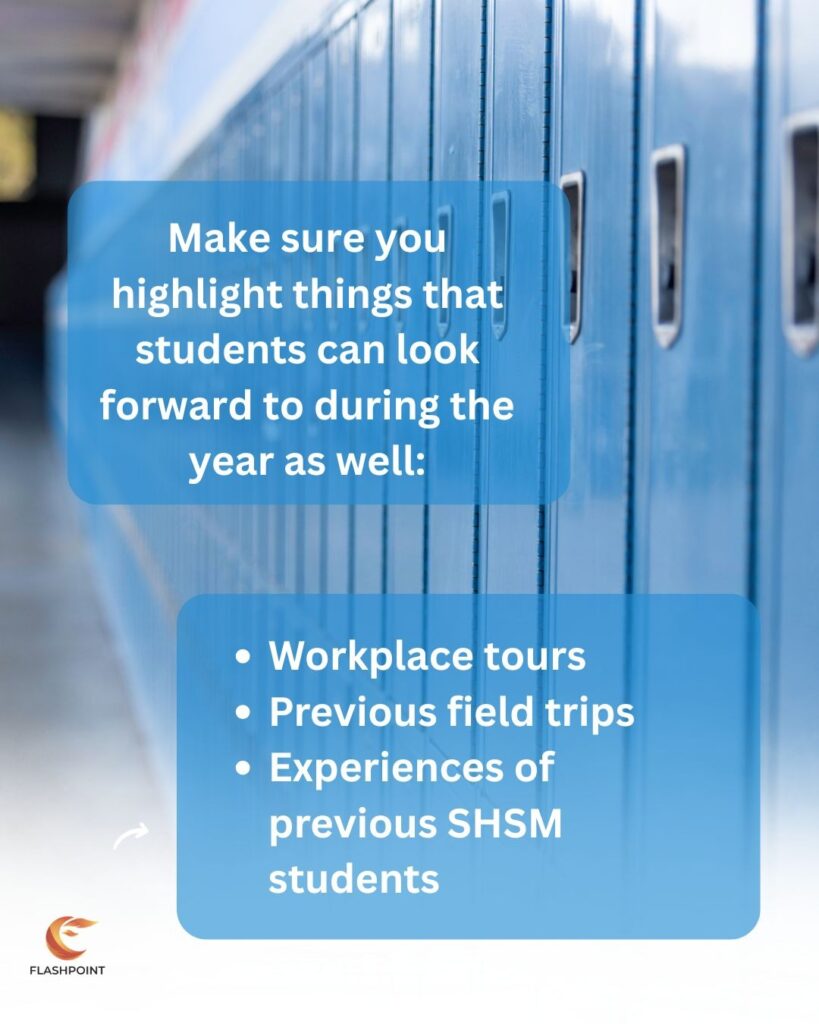
    Before reviewing program requirements, spend time highlighting what students can look forward to during the year.

    Talk about upcoming workplace tours.

    Share photos from previous field trips.

    Invite former SHSM students to speak about their experiences.

    Highlight certifications that employers value.

    When students understand the purpose behind the activities, participation tends to increase naturally.

    Reconnect With Employer Partners Early

    September is also an important time to reconnect with employers, community organizations, colleges, universities, and sector partners.

    Even if major events have already been scheduled, a quick conversation helps strengthen relationships and confirms expectations.

    Employers appreciate communication.

    They also appreciate knowing what students have already learned before arriving at the workplace.

    Strong partnerships are built through ongoing communication rather than last-minute requests.

    Review Workplace Expectations Before Students Need Them
    Many SHSM students will participate in workplace experiences within the first few months of school.

    Rather than waiting until immediately before co-op begins, review workplace expectations early.

    Topics such as professional communication, attendance, workplace etiquette, confidentiality, appropriate dress, and respectful behaviour should become part of classroom conversations from the beginning of the year.

    Students who understand these expectations early often approach employer interactions with greater confidence.

    Look Beyond Certifications

    One of the easiest traps for SHSM programs is measuring success by the number of certifications completed.

    Certifications are important.

    But they are only one component of a successful program.

    The real goal is helping students develop confidence, workplace readiness, career awareness, and transferable skills.

    As you plan the year, ask yourself whether every activity answers one simple question:

    How will this help students better prepare for life after high school?

    If the answer is clear, the activity likely has value.

    Build Community Within Your SHSM Cohort

    Students are more likely to stay engaged when they feel connected to one another.

    The beginning of the year is an excellent time to build relationships within the SHSM cohort.

    Simple activities that encourage students to share career interests, workplace experiences, or future goals help create a stronger learning community.

    Students often become valuable resources for one another throughout the year, sharing placement experiences, scholarship opportunities, and post-secondary advice.

    Set Expectations for Reflection

    SHSM is designed around experience.

    Experience alone, however, does not always produce learning.

    Reflection transforms experiences into meaningful career development.

    Introduce reflection early.

    Encourage students to think about what they hope to learn this year, the skills they want to develop, and the questions they still have about future careers.

    Returning to these reflections throughout the year helps students recognize their own growth.

    Remember Why SHSM Exists

    September can quickly become consumed by scheduling, emails, forms, transportation, and deadlines.

    Those administrative tasks are necessary.

    But they are not the purpose of SHSM.

    SHSM exists to help students make informed decisions about their futures.

    It helps young people connect classroom learning with careers.

    It introduces them to employers, workplaces, post-secondary pathways, and industries they may never have considered.

    Keeping that purpose at the centre of planning helps educators prioritize the experiences that matter most.

    Start Small, Then Build Momentum

    Not every exciting opportunity needs to happen during the first month of school.

    In fact, spacing experiences throughout the year often creates greater anticipation and engagement.

    Focus first on helping students reconnect with the program.

    Then gradually build toward certifications, employer engagement, experiential learning, co-op placements, and post-secondary planning.

    Students who understand the journey are much more likely to stay invested throughout the year.

    Final Thoughts

    The beginning of the school year offers something every SHSM Lead values: a fresh opportunity.

    A new group of students.

    New employer partnerships.

    New career conversations.

    New possibilities.

    While paperwork and planning are essential, the most successful SHSM programs begin by reconnecting students with purpose.

    When students understand why they are participating—and when educators intentionally build excitement, confidence, and career awareness from the first few weeks of school—the rest of the year tends to unfold much more smoothly.

    Every September is an opportunity to inspire students to think differently about their futures.

    As SHSM educators, that may be the most important work we do.

    Schools that partner with organizations such as Flashpoint SHSM Solutions often find that scheduling certifications, experiential learning opportunities, and career-focused programming early in the year helps create momentum that carries throughout the entire SHSM experience.

    Sources & Best Practice References

    Ontario Ministry of Education

    • Specialist High Skills Major (SHSM): Policy and Implementation Guide.

    Government of Canada – Skills for Success Framework

    • Career readiness, communication, adaptability, and lifelong learning competencies.

    Conference Board of Canada

    • Research on employability skills, career readiness, and school-to-work transitions.

    SEO Keywords: SHSM September planning, SHSM teacher guide, back to school SHSM, SHSM Lead resources, Ontario SHSM planning, SHSM best practices, career education Ontario, SHSM experiential learning, SHSM school year planning, SHSM teacher resources.

  • Can Students Be Paid for Placements — and Why Does It Matter?

    Can Students Be Paid for Placements — and Why Does It Matter?

    One of the questions that we always get, both from students and teachers, is can co-op students be paid for placements?

    Work placements are one of the most valuable components of both Co-operative Education (Co-op) and Specialist High Skills Major (SHSM) programs. They give students a chance to apply classroom learning in real workplaces, explore career options, and build skills that matter — regardless of whether they’re headed to apprenticeship, college, university, or the workplace. 

    But one question keeps coming up among teachers, students, and parents alike: Should a placement be paid or unpaid? The answer isn’t as simple as “paid is better.” What matters most — and what teachers need to communicate clearly — is how a work experience fits educationally and legally into SHSM and co-op requirements.

    The answer is that it depends. There is not a straightforward answer. It can change board to board with significant variance across the province.

    Understanding the Basics: What Co-op Is and Isn’t

    Co-operative Education (or “co-op”) in Ontario is a ministry-approved program that allows students to earn high school credits through workplace placements tied to their curriculum. These placements are arranged by the school and are designed to relate directly to classroom learning and career exploration. Ontario

    Most co-op placements for secondary students — including those in SHSM — are unpaid work placements. That’s because they’re fundamentally about learning, not employment. These unpaid placements earn students credits, help them explore careers, and build their portfolio of skills and experience. Ontario

    Paid vs. Unpaid: What’s the Difference (Legally & Practically)

    Unpaid Placements

    • Educationally Required: Unpaid placements are embedded within a curriculum course, especially co-op tied to SHSM. The priority is on learning outcomes, not compensation. Ontario
    • Legal Framework: In Ontario, unpaid placements are permitted only when they are part of a formal educational program — such as high school co-op, college co-ops, or professional practicums. Outside this framework, unpaid placements can violate employment standards. LaunchKO+1
    • Outcome-Focused: The goal isn’t income but skill acquisition, reflection, and documentation that aligns with curriculum expectations. Ontario

    Because SHSM requires students to complete two co-op credits directly connected to their sector, these unpaid placements are standard — and they count toward graduation and SHSM requirements. Upper Grand District School Board

    Paid Placements

    A paid placement means the student is treated as an employee under the Ontario Employment Standards Act (ESA). This has significant legal and logistical implications:

    • Minimum Wage & Employment Standards: If a student is paid, they must receive at least minimum wage and all other ESA protections (vacation pay, statutory benefits, etc.). LaunchKO
    • WSIB and Insurance: Paid students must be covered under workplace insurance appropriate to paid employees — which differs from how unpaid student placements are covered (often by the board or educational insurer). LaunchKO
    • Education vs. Employment: Paid work may not meet the Ministry of Education’s co-op criteria for curriculum-linked learning unless it is structured as a formal co-op program approved by the school. Ontario

    For SHSM students, this matters because only learning-focused placements can be counted toward co-op credits — they must include planned learning experiences, supervision, reflection, and assessment designed by the school. Ontario

    When Paid Work Can Be Compatible With SHSM Goals

    It is possible for a student to undertake paid work that supports their SHSM pathway — but not all paid jobs qualify as co-op or educational placements. Here’s how teachers can distinguish them:

    ✔ Approved Co-op Employers Offering Paid Co-op Roles

    Some employer partners are willing to pay students but structure the work as an approved co-op placement with a learning plan, supervision, and curriculum linkages. In these cases:

    • The student stays in the educational co-op framework.
    • The work still earns a co-op credit because it meets the Ministry and board criteria.
      Teachers must confirm ahead of time that the role will be treated as co-op with the school’s approval.

    ✔ Paid Work That Doesn’t Count as Co-op

    A student’s part-time job or casual paid work — even if it’s in a relevant sector — is not automatically a co-op placement. Unless the school structured it as part of a co-op course with learning objectives and assessment, it cannot be used toward SHSM requirements.

    Highlight this distinction to students: earning money is valuable, but it doesn’t substitute for co-op credit unless it’s formally recognized as such.

    Key Risks Teachers Should Help Students Avoid

    ❗ Misclassifying Work as a Co-op Placement

    A common pitfall is assuming that any job in a related sector counts as co-op. It does not — unless the school has integrated it into the co-op curriculum plan with learning, assessment, and supervision. Ontario

    ❗ Skipping Learning Plans

    Even with paid placements, students must have a Student Cooperative Education Learning Plan that identifies goals, activities, and assessment criteria before placement starts. Without it, the experience may be disallowed in SHSM audits.

    ❗ Ignoring Insurance and Legal Coverage

    Paid roles must be treated as employment; boards and employers need to establish correct insurance and safety coverage. Missteps here can put both students and schools at risk. LaunchKO

    What Teachers Should Tell Students (And Parents)

    Here are concise messages you can use with students — either in classroom presentations, individual planning, or parent communications:

    • “Paid work is great — but it only counts toward your SHSM co-op if we’ve approved it through the co-op program.”
    • “Unpaid co-op placements are educational first; they are designed to help you reflect on your learning, not just work.”
    • “Before you accept any job as part of SHSM co-op, let’s check if we can build a learning plan and link it to your curriculum.”

    Bottom Line: Protecting Students and Program Integrity

    Paid employment has real benefits — especially for students needing income — but it is not interchangeable with co-op placement unless properly structured. Unpaid co-op placements remain the core way that SHSM students earn credits, develop sector-specific skills, and demonstrate readiness for post-secondary pathways. Ontario

    Some school boards permit paid placements during summer,while others only after school. 

    Regardless of the school board position, it is important to set expectations and ensure that  students, parents and employers all understand the rules, responsibilities and expectations of the work placement.

    Your role as a teacher is to help students navigate the difference, make choices that align with both their learning and legal requirements, and ensure that every work experience counts toward their success — academically, professionally, and developmentally.

  • How Did Co-Op Requirements Change in 2025-6 for SHSM? Find Out Here…

    How Did Co-Op Requirements Change in 2025-6 for SHSM? Find Out Here…

    The Specialist High Skills Major (SHSM) program is entering the 2025–2026 school year with several important updates that directly affect how schools assign and track co-operative education credits. Although the overall structure of SHSM remains the same, the Ministry has introduced operational changes that educators need to be aware of when planning student timetables, placements, and graduation pathways.

    These changes don’t alter the purpose of SHSM or the number of co-op credits required—but they do influence how those credits can be earned and how they are recognized within the SHSM framework.

    The Co-op Requirement Itself Isn’t Changing

    Students are still required to complete two co-op credits that directly connect to their SHSM sector. This remains a core part of SHSM because it ensures every student gains authentic, sector-aligned experience—whether in health care, business, ICT, transportation, arts and culture, or any other recognized sector.

    Schools may still offer students the opportunity to earn additional co-op credits—up to six in total—depending on scheduling and placement availability. The minimum requirement, however, continues to be two.

    What Is Changing: More Flexibility in Co-op Delivery

    The most significant update for 2025–2026 is the Ministry’s expanded recognition of courses delivered under the co-op delivery type (OnSIS code “4”). Any course carrying this delivery code may now be counted toward the SHSM co-op requirement, provided the placement remains sector-relevant.

    For educators, this introduces meaningful flexibility. It allows newer or alternative co-op formats—such as community-based partnerships or innovative placement models—to be recognized more consistently. This can be especially helpful in schools that face placement shortages or run SHSM sectors with limited employer availability.

    In practice, this means schools can diversify co-op opportunities without worrying about whether the specific delivery structure will be accepted within the SHSM framework.

    New Priority Rules for Credit Allocation

    Alongside the delivery-type update, the Ministry has implemented a new system for applying credits to SHSM requirements. The updated rules prioritize credits in the following order:

    1. Higher-grade credits are applied first.
    2. When credits come from the same grade level, the earliest earned credit is applied first.

    This change is primarily administrative, but it does impact how credits appear when educators audit student progress. Guidance counsellors and SHSM leads may notice that credits populate differently in tracking tools and student information systems than they did in previous years.

    Early review of student SHSM bundles is recommended to ensure that credits are being applied as expected.

    Sector Relevance Remains Non-Negotiable

    Although schools now have more flexibility in how co-op courses are delivered, sector alignment is still mandatory. A placement must clearly match the student’s SHSM sector for the credits to count.

    This means learning plans, employer agreements, and documentation must continue to demonstrate a sector-specific connection. The expanded delivery type does not replace or reduce this requirement.

    What Schools Should Do Moving Forward

    Guidance Counsellors

    • Review how your SIS handles the new SHSM 25 credit-allocation rules.
    • Audit SHSM students’ credit progress early in the year.
    • Confirm sector relevance before approving placements.

    Co-op Teachers

    • Ensure co-op courses are using the correct delivery code.
    • Maintain strong documentation linking tasks to SHSM sectors.
    • Use the added flexibility to explore new or non-traditional placements.

    SHSM Leads / Administrators

    • Update any internal tracking sheets or checklists used for SHSM audits.
    • Share the new rules with staff involved in SHSM programming.
    • Review partnership opportunities that may now fit more easily into SHSM co-op requirements.

    A Clearer, More Flexible SHSM Landscape

    The 2025–2026 updates don’t change the heart of SHSM—they strengthen it. By providing more flexibility in co-op delivery and simplifying how credits are recognized, the Ministry has made it easier for schools to support diverse learners and offer more sector-relevant, meaningful experiences.

    For educators, the key shift is operational: the requirement stays the same, but the path toward fulfilling it is now more adaptable.

    By Carmen Reis, CPA, MA

    Carmen is the CEO of Flashpoint Training and Flashpoint Ignite. She can be reached by email at carmen@flashpointtraining.com